Window and deck bird feeders solve the two hardest placements in backyard birding. One goes on the glass, three feet from the chair where you drink your coffee. The other clamps to a railing you are not allowed to drill.
I hung my first window feeder the same year a white-throated sparrow hit my dining room glass and spent three days in a shoebox on the kitchen counter. That bird is why I care about placement as much as I care about seed. A feeder three feet from the glass is not decoration, it is strike prevention, and it happens to be the best seat in the house for watching a chickadee work a tray at arm's length.
This is the setup guide for both placements: how to choose the mount, where to put it, what to fill it with, and the cleaning routine that keeps the birds healthy. No drilling, no landlord conversation, and no seed rotting in a tray you forgot about.
Why you should trust me
I am a licensed wildlife rehabilitator in Madison, Wisconsin. I work part time at a small animal clinic and run the songbird side of a county wildlife rescue out of my garage, which means the incubator lives in the laundry room and the scale lives on the kitchen counter. I have been feeding backyard birds for twelve years and keeping the log for ten of them: every species that visits, every first-of-season date, and how many cups of seed each feeder draws per week.
The log decides what I recommend. My county list sits at 214 species, 38 of them have hit my feeders, and the feeder that photographs best rarely wins. What wins is a feeder that empties fast and comes apart in one motion.
I also see the other side of feeding. Every salmonella case that has come through rehab traced back to a feeder nobody took apart since fall. That is why half of this guide is about placement and cleaning instead of hardware.
How I picked and how I tested
No feeder gets written up here until it answers the same five questions I ask of every piece of bird gear:
- Will birds actually use it, or will it sit pretty and full while the cardinals eat somewhere else?
- Can I take it apart and clean it in under ten minutes?
- What does a determined fox squirrel do to it in week one?
- Will it survive a Wisconsin February, freeze, thaw, freeze?
- Would I still hang it after four seasons?
For this article the question narrows further, because the job is no-drill placement at the glass and on a rail. That eliminates anything that needs a pole in the ground, and it eliminates anything that relies on a vacuum seal through a hard freeze. What is left is a window mount and a clamp-on rail mount, and the two products below are the ones that fit the job.
Two specs decided everything, and both are worth checking against your own house before you spend a dollar. The window feeder is built for windows 27 to 35 inches wide. The railing feeder clamps on with no drill, which means it lives or dies on your rail. Measure both surfaces first. A feeder that does not fit your window or your rail is a return, not a project.
Before you mount anything: the three-foot rule
Placement matters more than the product. Get this wrong and you will spend spring cleaning up after window strikes, which is how I ended up in rehab work in the first place.
Mount a feeder within three feet of the glass, or push it out past thirty feet. Those are the two safe zones. The middle distance is the kill zone: a bird leaves the feeder, builds speed across the yard, and hits the pane at full tilt. At three feet it can barely get going. At thirty feet and beyond it has time to see the glass and veer.
The same logic makes window feeders the easiest feeders to place correctly. The mount is already at the glass, so the strike math is settled before you hang anything. A railing feeder is different. It sits out in the open, so check the sightline from the rail to your nearest big window and move it if the birds cross that line on their way to cover.
Three more placement rules from the log:
- Put it where you can reach it without a ladder. A feeder you cannot reach is a feeder you will not clean.
- Give birds an escape route. A feeder with a shrub or a tree within a short hop gets used faster than one hanging in open air, because every bird on it is watching for the neighborhood hawk.
- Watch the afternoon sun. Seed bakes in a south or west exposure, and wet seed plus heat is a mold factory.
The mounts you'll need before you start
Both of these are no-drill. That is the entire point: you can set up a real feeding station on a rented apartment, a second-floor balcony, or a window you look out of all day.
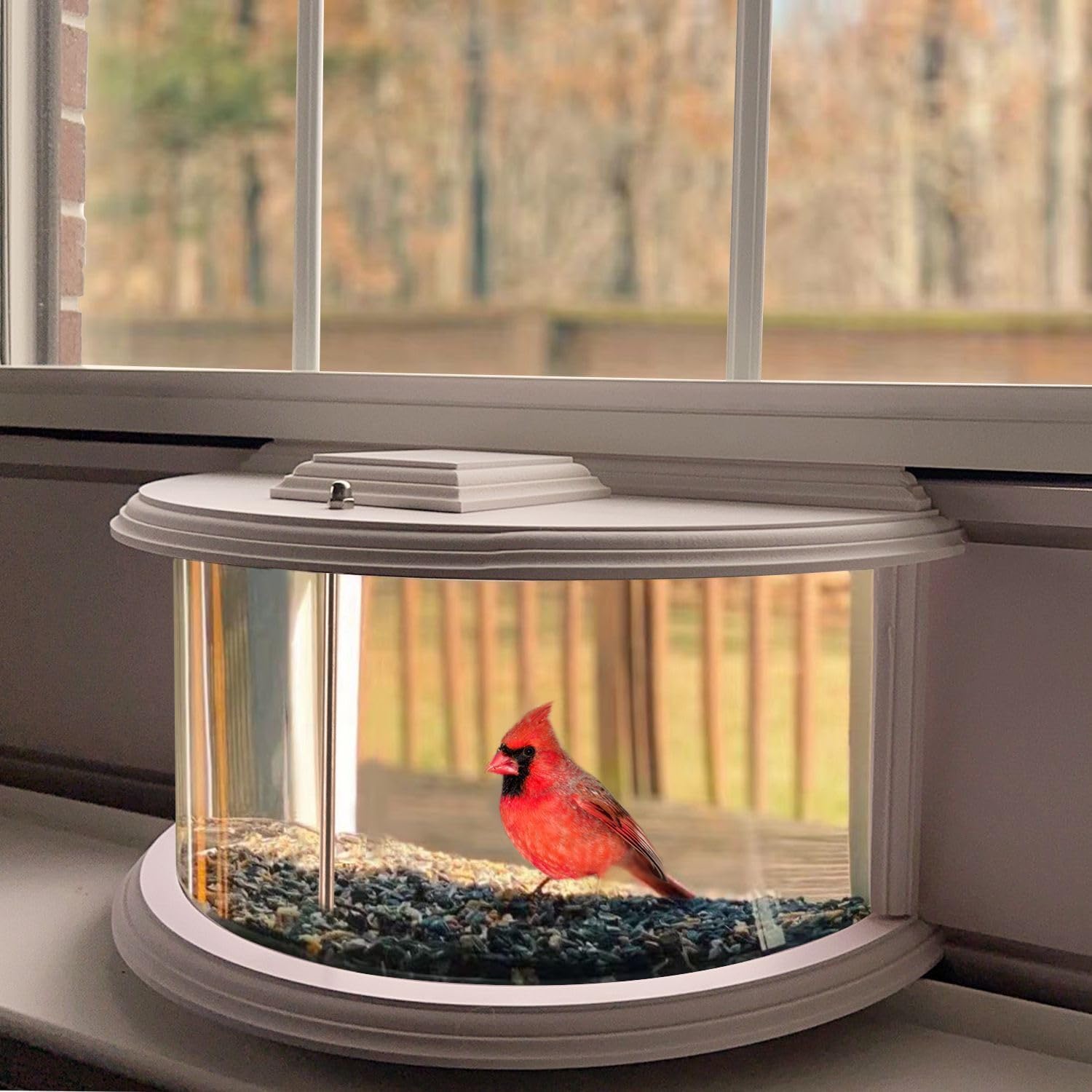
Window pick: in Window Bird Feeders for Viewing - 180° Clear View Bird Feeder, Durable, Elegant, Fits Windows 27-35" Wide, for Bird Watching-Bring Joy to Your Home
 Visit on Amazon →
This is a window-mounted feeder built for viewing, with a 180 degree clear view through the pane and a fit range of 27 to 35 inches wide. That width number is the first thing to check against your own glass. Measure the window you plan to use, frame included, before you order, because this is the one spec that decides whether the whole project works.
The reason I like this style of feeder is that it removes the hardest variable in bird feeding. Placement at the glass is already strike-safe, and the birds land close enough that you start learning markings instead of silhouettes. You will know your house finches from your purple finches by the second week.
Because it lives in your face, it also gets cleaned. Window feeders are the ones people actually maintain, and that matters more than any feature on the box, since a feeder at the sill is inches from where a sick bird will sit.
Flaws but not dealbreakers: It is exposed. Afternoon sun heats the seed, and a driving rain will damp whatever is in the tray, so plan on emptying wet seed rather than topping it off. Check current Amazon price.
Anyone in an apartment, a rental, or a home office with a good window will get more use out of this than out of a pole feeder in the far corner of a yard.
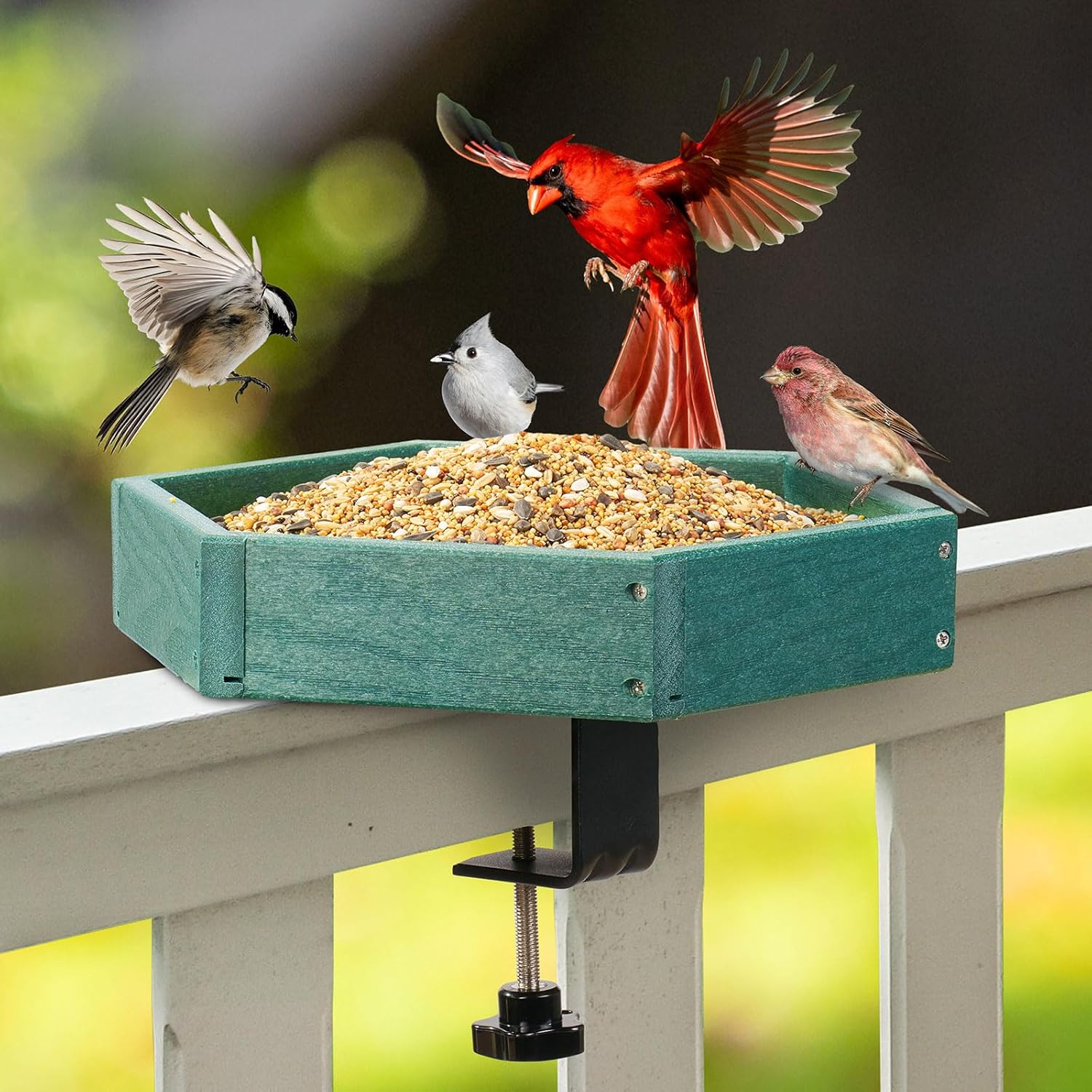
Railing pick: Kingsyard Clamp-On Deck Bird Feeder for Balcony Railings, No Drill
 Visit on Amazon →
This one clamps onto a deck or balcony railing with no drilling at all, which is the whole reason it exists. If you rent, if your HOA has opinions, or if you simply do not want holes in your rail, a clamp-on is the answer. It tightens by hand and comes off in seconds when you need to clean it or when the weather turns.
On a rail, position matters. Squirrels use railings like highways, so watch where yours runs before you commit, and put the feeder where a squirrel has to work for it rather than where it can stroll up and sit down. Wind is the other factor: an exposed rail takes gusts that a sheltered window does not, so check the clamp tension every week and bring the feeder inside ahead of a storm.
The rail is also a viewing position, not just a mounting surface. A second-floor deck puts you above the yard, which is a completely different angle on the same birds, and it is the only way to feed on a balcony with no ground access.
Flaws but not dealbreakers: Fit depends on your rail. Measure the thickness before you order and confirm the clamp closes on it. And anything clamped to a rail can be knocked loose, so it is not the mount for a spot with constant foot traffic. Check current Amazon price.
Anyone with a balcony, a deck rail, or an upstairs landing they look out on will get the most out of this.
The actual setup workflow
Now the part you came for. This works with either mount, and it works the same in September as it does in February.
Step one: Measure before you order. Window: 27 to 35 inches wide for the window unit. Rail: thickness and shape for the clamp-on. Write the numbers down and compare them to the product listing before checkout. This one step prevents most returns in backyard birding.
Step two: Choose the placement using the three-foot rule. At the glass, or past thirty feet. Nothing in between.
Step three: Set the height for your eyes, not for the birds. Birds will use a feeder at almost any height. You will only study it closely if it sits near eye level when you are seated. Put it there.
Step four: Fill it with seed birds actually eat. Black oil sunflower and sunflower hearts are the two I buy. Skip anything padded with milo or red millet, because filler gets kicked to the ground, molds in the rain, and means more cleaning for zero birds. If you have a deck or an HOA, a no-mess blend costs more per pound and saves you the hull litter and the neighbor complaint.
Step five: Add water. From June through August the bath gets more entries in my log than every feeder combined. Water brings species that never touch seed.
Step six: Do not fill to the top in week one. A new feeder gets found over days, not hours. Partly filled seed empties before it can spoil, and spoiled seed is the fastest way to lose a feeder's visitors.
Step seven: Give it two weeks. The first arrivals are usually chickadees, house finches, and, if you are lucky, a downy woodpecker. Birds find new feeders by watching other birds, so the first customer does the advertising for you.
Step eight: Set a cleaning day and keep it. Weekly. Take the feeder apart, wash it in soapy water, rinse it in a diluted bleach solution, and let every part dry completely before it goes back up.
Step nine: Run a winter check. Freeze and thaw is what kills mounts, and it is what let a suction-mounted feeder of mine let go at six below zero, tray and all, onto the porch. After every thaw, check the clamp or bracket, and pull any seed that got wet. Wet seed does not go back in the feeder.
The cleaning routine that keeps birds alive
A dirty feeder is a disease vector with a perch. House finch eye disease and salmonella both run through feeder congregations, and I have seen the intake records to prove it. Every case I have handled traced back to a feeder that had not been taken apart since fall.
So the routine is not optional, and it is not a hose spray. Seed dust and droppings collect in the seams, and a rinse over the top does nothing to them. Disassemble, scrub, rinse, dry. Ten minutes, once a week, and the log shows the payoff in steady species counts instead of boom and bust.
I will admit the log also shows a two-week gap every August, when the garden takes over and the feeders get ignored. I pay for it in extra scrubbing every September. Do as I say on this one, not as I do.
The competition and why it lost
If you own your home and can put a pole in the ground, a pole system with a baffle is still the better long-term answer, and that is a different article. This guide is for the placements where a pole is not an option.
Ground trays and platform feeders lost here because they feed everything: raccoons, cats, and the wrong half of the mammal kingdom. They also soak in the rain and need the most cleaning of anything I have run.
Suction-cup-only mounts lost for a different reason. A vacuum seal is a Wisconsin February away from failing, and I have the dented tray to prove it. If a mount has to hold through a freeze, I want a mechanical connection, not a seal.
Plain tube feeders on a shepherd's hook lost on the no-drill requirement, since the hook still has to go into something, and on placement, since a hook in the middle of the yard sits right in the strike zone.
That leaves the two roles this article covers: a window unit for close viewing and strike safety, and a clamp-on rail unit for balconies and decks where nothing can be drilled.
What this all costs
The hardware is the cheap part. Both mounts here are one-time purchases, and you can check current Amazon price on each of them above. After that, the recurring costs are seed, cleaning supplies, and a water source.
Seed is where the money actually goes, and it is where the cheap choice is the expensive one. Filler blends cost less per bag and more per bird, because half the bag ends up on the ground and you clean the tray twice as often. Buy sunflower in the largest bag you can store dry, and buy no-mess blend only when the deck or the HOA demands it.
The real budget line is time. Ten minutes of cleaning a week, a couple of minutes of refilling a day, and one honest look at the feeder after every thaw. Over a season that is a few hours, and it is the difference between a feeder that lasts and a feeder that becomes a disease vector with a perch.
Set the window unit three feet from the glass, clamp the rail unit where a squirrel has to work for it, measure before you order, and clean on a schedule. That is the whole job, and it is a job the birds will pay you back for by February, when the yard is otherwise silent and the log still has entries.