Window bird feeder placement is the whole job. Get it right and a black-capped chickadee is on the perch before your coffee finishes brewing. Get it wrong, hung twelve feet out from the pane instead of three, and you have built a window strike trap with a seed tray bolted to it.
I have fed backyard birds in Madison, Wisconsin for twelve years and kept the log for ten of them. The log is a spreadsheet: every species that visits, the first-of-season date for each migrant, and how many cups of seed each feeder draws per week. Ten years of that data decides every recommendation I make. The log does not care how a feeder looks in a product photo. It cares about draw, which is how fast a feeder empties, and about whether I can take the thing apart and scrub it before the seed turns.
So this is the setup I would hand to a neighbor who just moved in: a clear window feeder for the glass, a squirrel-resistant hopper for the pole, and the placement, seed, and cleaning routine that makes both of them worth hanging. No feeder earns a spot on my fence without a full season in the yard and an entry in the log, and both of the feeders below have one.
Why you should trust me
I am a licensed wildlife rehabilitator. I work part time at a small animal clinic and run the songbird side of a county wildlife rescue out of my garage, which means the incubator lives in the laundry room and the gram scale lives on the kitchen counter. Rehab birds get weighed in grams, seed gets measured in cups, and both numbers end up in the same log.
That log is why I write about feeders the way I do. My county life list sits at 214 species and 38 of them have hit my feeders, so I know what a feeder looks like when birds actually commit to it and what it looks like when they visit once and never come back. I also know what a dirty feeder does, because I have taken in house finches with eye disease and birds with salmonella, and in almost every intake I could trace it back to a feeder nobody had taken apart since fall.
I test squirrel claims the same way I test everything else. A feeder goes up, the neighborhood fox squirrels get three weeks with it, and if one of them reaches seed even once, the write-up says resistant, not proof. That distinction is the entire reason this article has a pole feeder section instead of a paragraph about how nothing works.
How I picked and how I tested
Two feeders, two different jobs, and I am not padding the list. A window feeder solves a viewing problem and a strike problem. A pole feeder solves a capacity problem and a squirrel problem. Buying three of either does not help you.
Every feeder I recommend has to pass five questions. Will birds actually use it, or will it sit pretty on the pole? Can I take it apart and clean it in under ten minutes? What does a determined fox squirrel do to it in week one? Will it survive a Wisconsin February, where the temperature freezes, thaws, and freezes again inside a single week? And would I still hang it after four seasons?
For the window unit I looked at the suction cups first, because cups that let go at the first hard freeze are the number one complaint I hear from people who feed birds in cold country. Then I looked at how the tray comes off for cleaning and whether the acrylic distorts the view, since a window feeder you cannot see through is just an expensive bird perch.
For the pole unit I looked at seed capacity, because capacity is really a refill-frequency spec, then at how the hopper opens, how the ports are arranged, and whether the whole thing can be rinsed and dried without a screwdriver. Capacity cuts both ways: a big hopper means fewer trips outside in January, and it also means more seed sitting in the weather, so the cleaning schedule has to be tighter, not looser.
What I did not do is guess at numbers. I am not going to print a rating or a price at you, because those move and my log does not track them. Check current Amazon price when you are ready to buy, and spend your attention on placement instead.
The feeders I would start with
These are the two I would put up first, in this order, because the window feeder is the one that gets birds close enough to actually learn from.
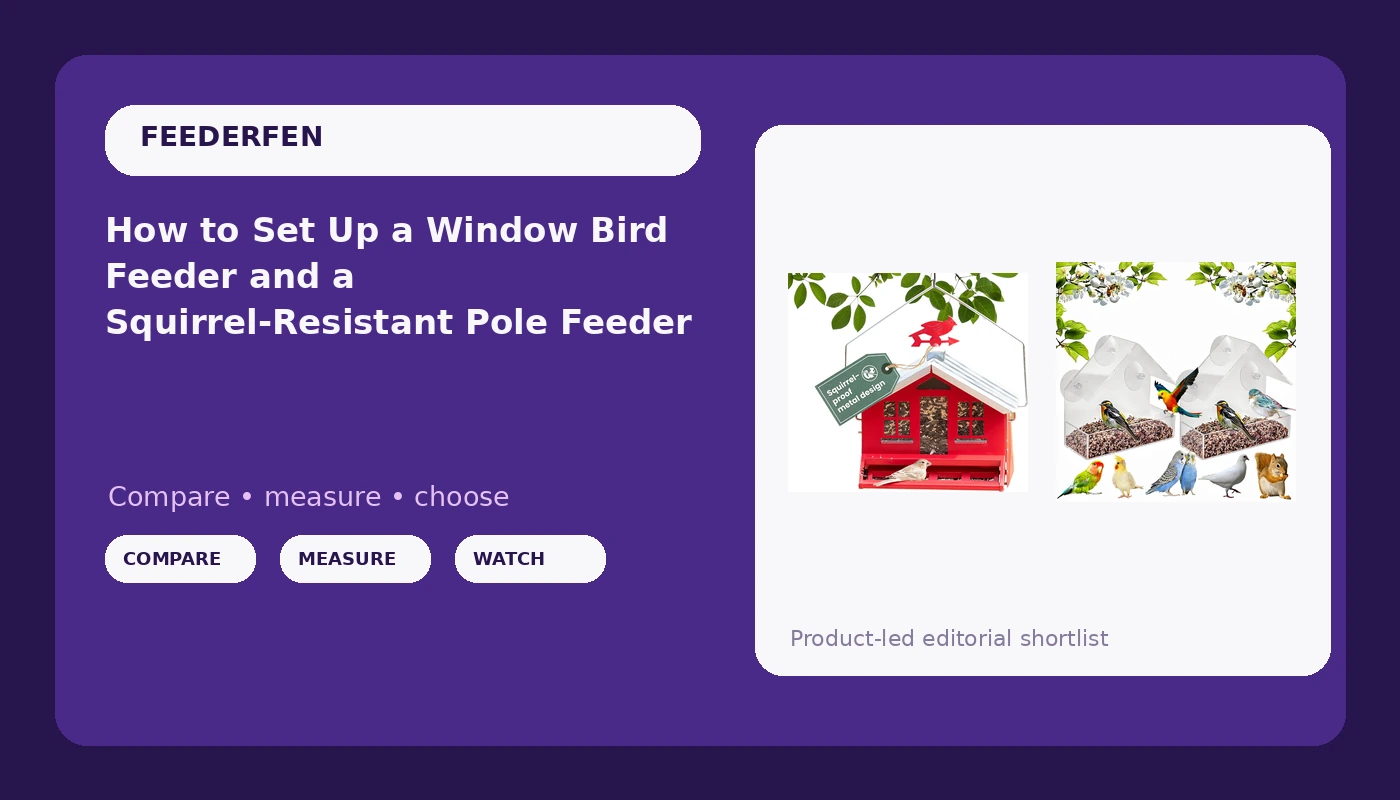
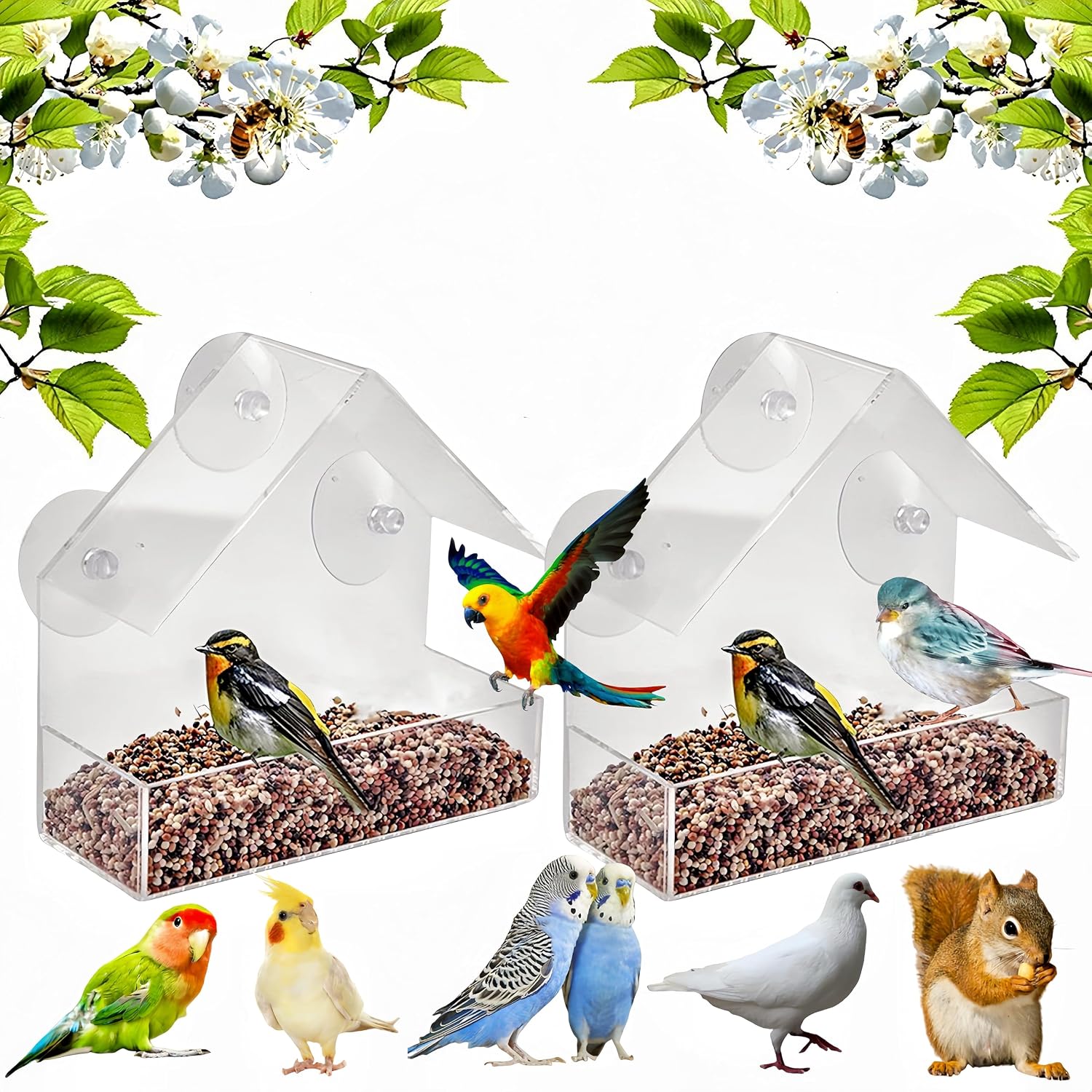
Our pick: 2 Pack Window Bird Feeder for Outdoors Clear Feeders Window Mounted with Strong Suction Cups Fummingbird Feeder Acrylic Birdfeeders for Viewing Wild Birds Outside, Interactive Cat Toys
 Visit on Amazon →
The listing calls it a hummingbird feeder and a cat toy. What you actually get is a clear acrylic tray that mounts to glass with suction cups, and you get two of them. That two-pack is the feature I care about most, because it means one feeder can be hanging on the window while the other is drying on the dish rack, and my cleaning schedule never slips just because the feeder is busy.
The clear acrylic is the other thing it gets right. A window feeder exists so you can watch birds from three feet away, and you cannot do that through cloudy plastic. This one keeps the tray low profile, which puts the birds at eye level with a kitchen chair instead of above your head.
Now the honest part. Suction cups are the weak point of every window feeder ever made, including this one, and if you live somewhere that hits single digits, you should plan on pressing them back against the glass after every freeze and thaw. Wipe the glass with warm water and let it dry completely before you press the cups on, and wipe the cups themselves while you are at it, because a film of pollen or kitchen grease is what kills the seal. The small tray also means a smaller draw, so you will refill more often than you would a hopper, which is a feature if you like watching birds and a chore if you do not.
Flaws but not dealbreakers: The suction cups will not survive a hard winter without you checking them, and the tray holds less seed than any pole feeder on the market. If your windows are old, single-pane, or pitted around the edges, mount this on the smoothest pane you have.
Anyone who wants birds at arm's length, and anyone who has a window that has already taken a strike, should start here. Check current Amazon price before you order, and order the two-pack rather than a single.
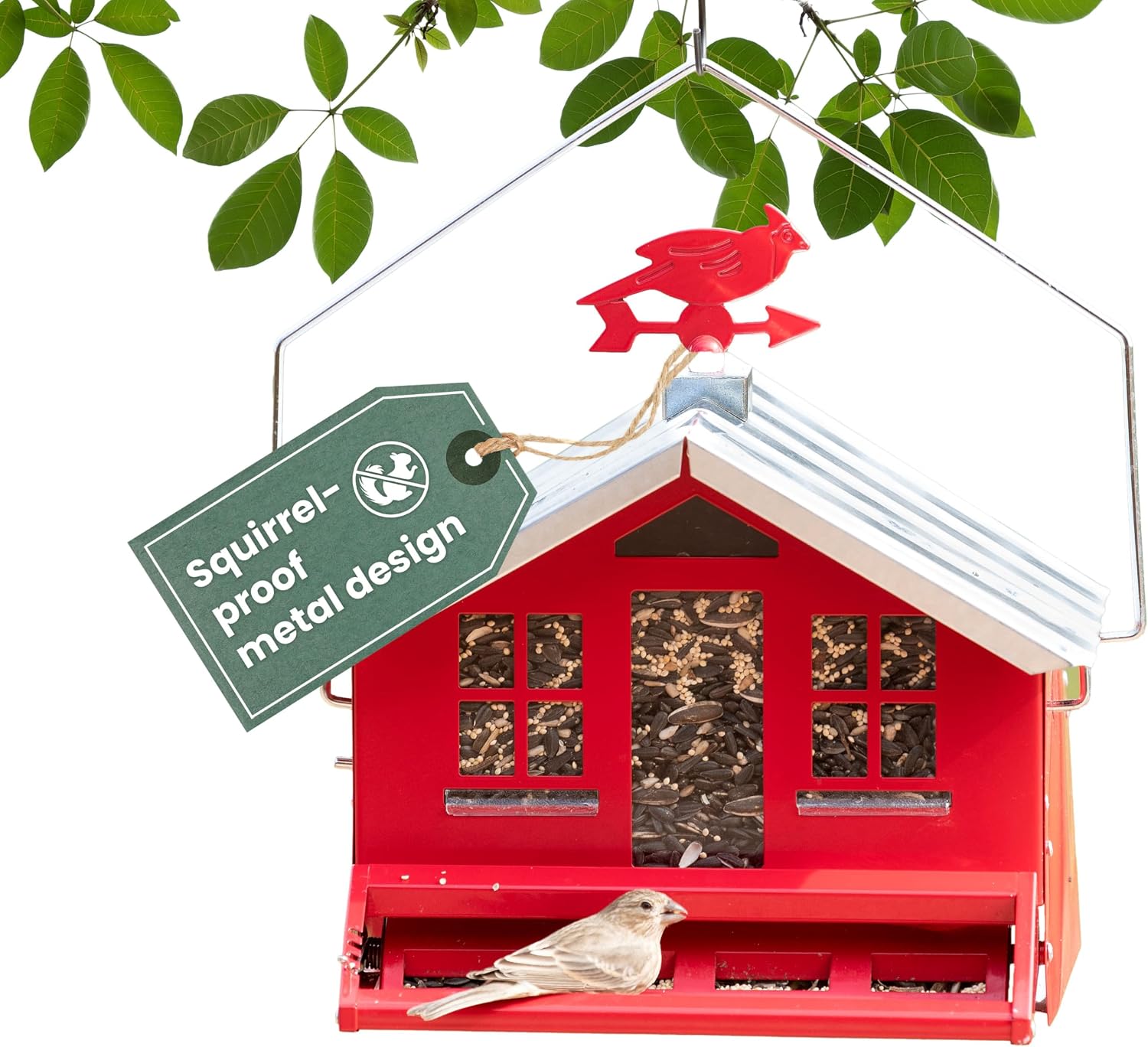
Runner-up: Perky-Pet Squirrel-Be-Gone II Country Style Bird Feeder, 8 lb Seed Capacity
 Visit on Amazon →
This is the other half of the yard. Eight pounds of seed capacity is a refill-frequency spec more than anything else, and eight pounds is the size where a busy yard in January stops needing a daily top-off. The country style hopper shape sheds weather better than an open tray, and the seed sits behind a housing instead of in the rain.
It is squirrel-resistant, and I want that word read carefully. Resistant means the design raises the cost for a squirrel, and placement does the rest of the work. If you hang this where a fox squirrel can launch onto it from a fence rail, a low roof, or an overhanging branch, the mechanism is not going to save you. Put it on a pole, ten feet from anything a squirrel can jump from, with a baffle below the feeder, and it holds up.
Cleaning is where a hopper earns or loses its place in my yard, because a large capacity means seed sits longer. Empty it fully, take the housing apart, scrub the inside with hot soapy water, and let every surface dry before it goes back together. Seed that clumps or smells musty goes in the trash, not back in the hopper.
Flaws but not dealbreakers: It is not squirrel-proof, no matter what the box implies, and it is heavier than it looks once it is full, so mount it at a height you can reach without a ladder. Buy a pole and a baffle in the same order or you will be improvising.
Anyone with a yard, a pole, and a squirrel problem that has already beaten a plastic tube feeder should go straight to this one. Check current Amazon price, then spend the saved trip on a baffle.
The actual setup workflow
This is the part that decides whether you get birds or an empty tray. It takes about an hour the first time.
Step one: Pick the window before you pick anything else. A feeder goes either three feet or closer to the glass, or more than thirty feet away. There is no useful middle. Close in, a bird leaving the perch cannot build up enough speed to hurt itself, which is exactly why my first window feeder went up three feet from the dining room glass that took a white-throated sparrow. If you have a cat, pick a window the cat cannot sit in, because a cat on the sill empties a feeder faster than a hawk does.
Step two: Clean the glass. Warm water, a drop of dish soap, no streaks, and dry it fully. Then wipe the suction cup spots again. This sounds fussy and it is the single biggest factor in whether the cups hold through a cold snap.
Step three: Mount the window feeder at eye level. Sit in the chair you will watch from and hold the tray up until the perch lands where you want it, usually just below your line of sight. Press each cup firmly against the glass and give the whole feeder a light tug before you walk away. If a cup pops off, clean the spot and try again rather than pressing harder.
Step four: Fill it light at first. Start with a cup or two of black-oil sunflower or a no-mess blend, not a full tray. New feeders with wet seed in the bottom are how mold gets started. Skip any blend padded with milo and red millet, because those fillers get kicked to the ground, sprout, and mold, and then you are cleaning a platform twice as often for no reason.
Step five: Set the pole. Five to six feet up, eight to ten feet from cover so birds have somewhere to retreat to, and at least ten feet from any launch point a squirrel can use. A baffle below the feeder does more for your seed bill than any mechanism inside the feeder itself.
Step six: Give the yard two weeks. Birds find feeders by sight and by watching other birds. The first customer is usually a chickadee or a house finch, and the crowd follows within a week or two. Water helps more than people expect, and a bath in the yard brings species that never touch seed.
Step seven: Put cleaning on a schedule, not on a feeling. Every feeder gets taken apart, scrubbed with hot soapy water or a diluted bleach solution, rinsed, and dried fully, once a week. Twice a week in summer heat, and immediately after any stretch of rain. A feeder that is a chore to take apart does not get cleaned, and a feeder that does not get cleaned becomes a disease vector with a perch on it.
Step eight: Recheck after every freeze and thaw. Press the suction cups back against the glass, shake ice out of the hopper, and break up any clumped seed. Winter is when window feeders fail and when hoppers sit wettest, so this is a two-minute check that saves a feeder.
The competition and why it lost
Most of what you will see in a search results page fails one of my five questions before it ever gets hung.
The plastic tube feeders with "squirrel-proof" printed on the box and a two-week warranty are the clearest case. The claim is a marketing word, the ports are sized for a squirrel's jaw, and the seed is gone in a week. A squirrel-resistant feeder with a real baffle and honest placement beats a "proof" claim every time.
The bare suction cup feeders with no bracket and no backup are the second category, and I have watched one let go at six below zero and hit the porch. Suction cups are fine on a sheltered window if you check them. They are not fine on an exposed pane in a hard freeze, and no listing photograph changes that.
Then there are the giant hoppers, the ones that hold twenty pounds and hang from a branch. Capacity without a cleaning plan is a mold farm, and a feeder that size on a branch is a squirrel staircase. The nyjer socks are lovely and rot quickly in rain. The hummingbird feeders with red dye in the nectar are unnecessary, since the birds do not need the color and you are just adding something to the water. Every one of those products loses to a small clear window tray and a well-placed pole hopper.
What this all costs
I am not going to quote prices, because they move and this article should not go stale. Check current Amazon price on both feeders and do the math against what you already spend on seed.
Here is the math that actually matters. A window feeder two-pack costs less than one bag of good seed, and the second unit is what keeps you cleaning on schedule instead of skipping a week. The pole feeder costs more up front because of the capacity, and the capacity is what saves you trips outside in January. Both of them outlast the cheap alternatives by years, not months, as long as you take them apart.
The variable nobody prices is cleaning. A feeder you scrub weekly lasts five seasons. A feeder you never take apart gets replaced in two, and the seed you throw away because it molded costs more than the feeder did.
- Weekly take-apart cleaning: free, and it is the single best thing you can do for the birds in your yard.
- A spare window feeder drying on the rack: already included, and worth more than it sounds.
- A baffle under the pole: buy it with the feeder, not after the first squirrel.
That is the whole job. Hang the window feeder three feet from the glass, put the hopper on a pole ten feet from anything a squirrel can climb, fill both with seed that birds actually eat, and take them apart every week. The log will tell you the rest.