Most window feeders fail for one of two reasons: the cups let go, or the feeder is mounted where birds hit the glass. Both problems are solvable before you stick anything to the pane, and solving them is what turns a cute gift into a feeder your notes actually fill up with.
I have kept a feeder log for ten years. One row per day, species, first-of-season dates, and cups of seed drawn per week. That log is why window bird feeder placement matters more to me than what the feeder looks like. A feeder within three feet of glass gets worked all winter and kills almost nothing. The same feeder at eight feet gets worked just as hard and turns your window into a hazard. The birds do not care about the difference. You have to.
Here is the setup I walk people through: choose the right pane, mount the window feeder so it holds, hang a second feeder to carry the traffic, and clean both often enough that you are not running a disease vector with a perch.
Why you should trust me
I am a licensed wildlife rehabilitator in Madison, Wisconsin. I work part time at a small animal clinic and run the songbird side of a county wildlife rescue out of my garage, which means the incubator is in the laundry room and the scale lives on the kitchen counter. I have been feeding backyard birds for twelve years and keeping the log for ten. My county life list sits at 214 species, and 38 of them have hit my feeders.
I got into rehab because a white-throated sparrow survived a window strike on my dining room glass and spent three days recovering in a shoebox. The same year I hung my first window feeder three feet from that glass, which is exactly where it belongs.
In rehab I see the other side of feeding: house finch eye disease and salmonella in intake birds, both of which trace back to feeders nobody took apart in months. I weigh every rehab bird in grams and count seed in cups, and both habits shape what follows.
How I picked and how I tested
A few rules decide what gets written up here. No feeder gets recommended without at least one full season in my yard and an entry in the log. No squirrel claim gets repeated unless a neighborhood fox squirrel has had three weeks to defeat it. No seed gets recommended if the ingredient list leads with milo or red millet.
For a window setup specifically, I look at four things: does the mount hold through freeze and thaw, can I take the feeder apart to clean it, does the seed stay dry, and how fast does it empty. That last one is the draw, and draw tells you more than capacity. A small feeder that empties every four days is doing its job. A big one that sits half full for three weeks is growing mold.
I have had a suction cup let go at six below zero and send a tray onto the porch, so I am not romantic about cups. I have also watched a window feeder with clean glass and fresh cups hold a full load of sunflower hearts through a wet October without moving. The difference is prep, not luck.
The two feeders I would use for this setup
One feeder mounts on the glass. The other hangs, either at the edge of the window or well out in the yard, and takes the traffic the window feeder cannot hold. You do not need both, but the pair is what makes a window station busy without making it dangerous.
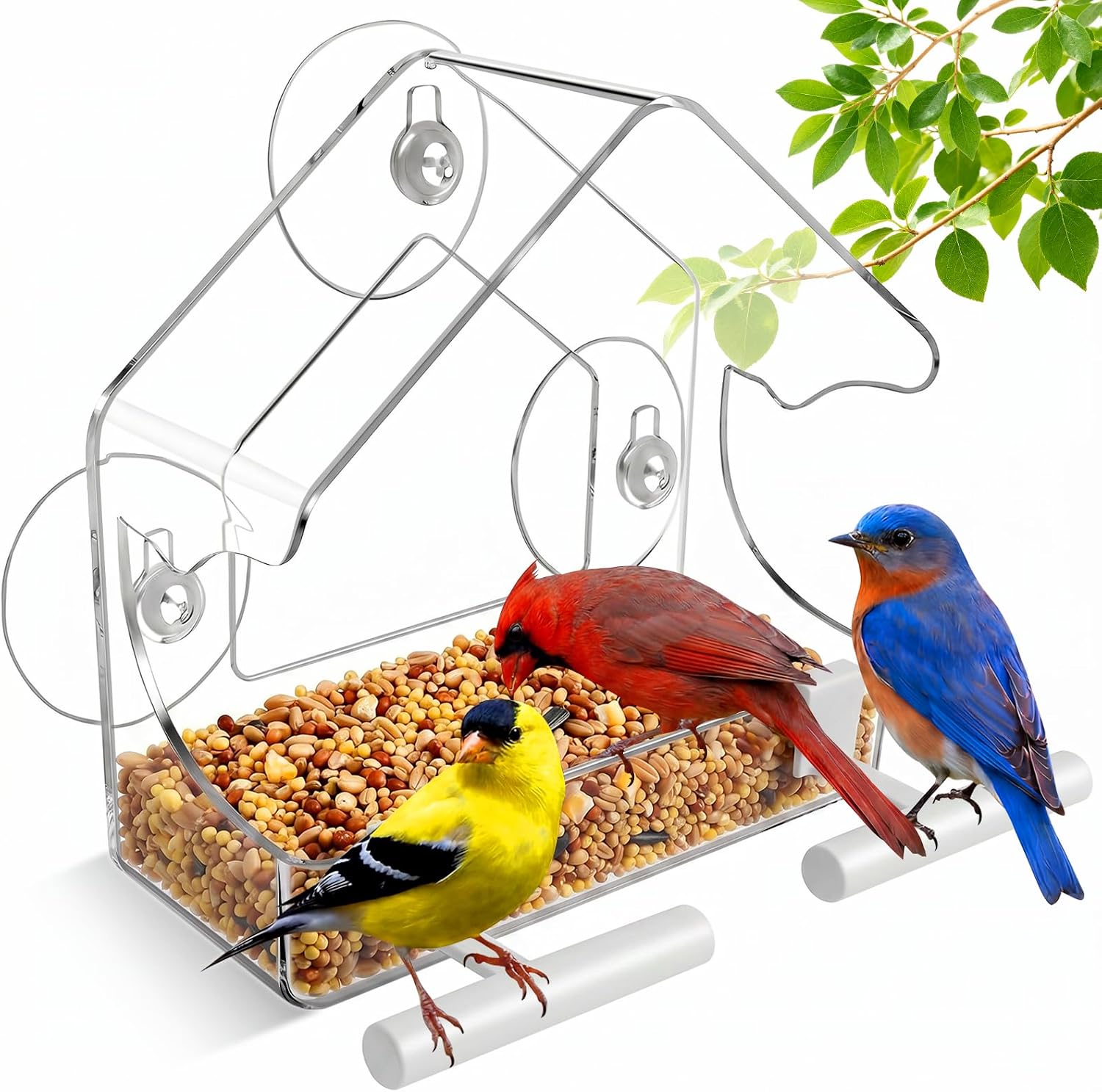
Budget pick: Window Bird Feeders with Strong Suction Cups, as a Bird Watching Gift
 Visit on Amazon →
This is the cheapest way to find out whether birds will come to your glass at all, and it is the one I would hand a renter, a dorm resident, or anyone in an apartment who cannot put a pole in the ground. Suction cups mean no hardware, no landlord conversation, and no holes in anything. Mounted on clean glass in the middle of a pane, at a height where you can reach the fill opening from inside, it puts chickadees and house finches close enough to watch without binoculars.
Flaws but not dealbreakers: Cups are the weak point. They hold best on glass that has been washed and wiped with rubbing alcohol, and they hold worst in a hard freeze. If January means single digits where you live, plan to bring the feeder in for the coldest stretches and let the hanging feeder carry the winter. A cup that has popped once will pop again, so replace it rather than pressing it back on.
Anyone who wants a low-commitment first feeder, or a feeder for a kid who checks it every morning before school, will get their money's worth here.
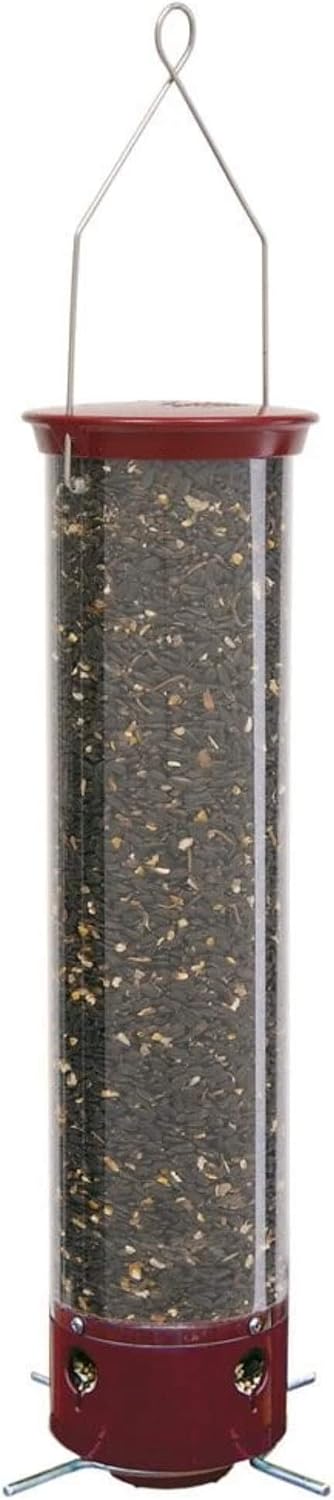
Our pick: Droll Yankees YCPD-90M Yankee Dipper Bird Feeder, 5 lb, Burgundy
 Visit on Amazon →
This is the hanging half of the setup and the larger purchase by a wide margin. Five pounds of seed capacity means you are not refilling every other day, which matters because the whole point of the second feeder is to absorb traffic so the window feeder stays a close-up view instead of a crowd. Hang it from a hook at the edge of the window, from a pole arm, or from a sturdy branch, and it becomes the feeder your log fills up from.
The name on it is Droll Yankees, which has been building feeders for a long time, and a 5 lb capacity puts it in the class where a feeder is expected to last multiple seasons rather than one. Burgundy is the finish.
Flaws but not dealbreakers: A hanging feeder with real capacity invites squirrels, and no feeder wins that fight by default. Treat any squirrel claim, including mine, as something to test for three weeks rather than a fact on a box. A baffled pole or a hook with a baffle above it is the difference between a feeder and a squirrel buffet.
Anyone who is done buying feeders every spring and wants one that will still be on the hook in four winters should start here.
The actual setup, step by step
This is the part that decides whether birds use the setup or die against it.
Step one: pick the pane. Choose a window you actually look at, because a feeder you never see is a chore instead of a hobby. Then choose one you can reach, since you will be filling it in the rain in November. A window over a deck or a porch rail is ideal. A window over a concrete walkway is not, because spilled seed and ice both land there.
Step two: measure before you mount anything. The distance from glass to feeder is the number that matters. Keep the window feeder on the glass itself. Any second feeder belongs either within three feet of the glass or more than thirty feet away. The zone in between, roughly three to thirty feet, is where birds build up enough speed to hurt themselves. Walk it once with a tape measure and you will never guess again.
Step three: clean the glass and the cups. Warm water, a drop of dish soap, dry it, then wipe the mounting spot with rubbing alcohol and let it evaporate. Suction cups fail on dust, pollen, and kitchen film far more often than they fail on weight. Press each cup on firmly and give the feeder a gentle tug before you fill it. Install on a mild day if you can, because a cup that goes on in the cold never seats as well.
Step four: fill it properly. Black-oil sunflower or sunflower hearts, nothing else. Small feeders punish cheap blends, because milo and red millet get kicked onto the sill, get wet, and mold where you cannot see it. Sunflower hearts leave no hull litter under the window, which matters if the feeder hangs over a deck or a neighbor's parking spot.
Step five: hang the second feeder. If you have a hook at the window, hang the hanging feeder at the glass line so it also falls inside the three foot rule. If you do not, put it on a pole past thirty feet, in the open with a shrub or a tree within ten feet for cover. Either position works. The middle of the yard, at fifteen feet from the glass, does not.
Step six: set a cleaning schedule and write it down. Once a week, take the feeder apart, scrub every surface with hot soapy water, rinse, then soak in a dilute bleach solution and rinse again. Dry it completely before refilling. This is not optional maintenance. In rehab I see the intakes, and they come from feeders that got a hose spray instead of a disassembly. A small window feeder needs this more often, not less, because rain sits in it and the seed turns before it empties.
Step seven: plan for winter. Suction cups and hard freezes do not mix. Bring the window feeder inside before the first stretch of single digits, or accept that you will be checking the cups every morning. Leave the hanging feeder out, keep it filled, and let it carry the season. Water matters as much as seed in winter, so keep a bath open if you can.
Step eight: keep the log. Two weeks of notes beats any review, including this one. Record species, first-of-season dates, and cups per week. When a feeder empties in four days instead of nine, you will know it is working, and you will know which seed is actually getting eaten.
What did not make the cut
Some setups I would not put at a window. A single small cup feeder is fine for a chickadee and useless for a cardinal, so it works only as a supplement to a real feeder. A tube feeder mounted on the glass looks tidy and is a nightmare to take apart, which means it will not get cleaned. Nyjer at a window sounds clever until the mesh sits in the rain and the seed rots. Suet at a window in July turns rancid and drips.
Big hopper feeders fail for the opposite reason. They hold so much seed that a light yard leaves it sitting for weeks, and stale, damp seed is the fastest way to make birds sick. Match capacity to traffic. If you do not know your traffic yet, start small and let the log tell you.
The other thing that did not make the cut is the middle distance. Every feeder I have seen hung eight feet from a window was an accident waiting to happen, regardless of how good the feeder was.
What this costs and how it holds up
Two feeders, one cheap and one not, plus seed and a bottle of bleach. Check current Amazon price on both before you decide, because the window feeder is the trial and the hanging feeder is the commitment. The window feeder is the least expensive part of the whole setup by a wide margin, which is exactly why it makes sense first: you learn whether birds will come to your glass before you spend real money.
The hanging feeder is the bigger line item and the one that should last. One feeder that survives four winters costs less per season than three that do not, and that math holds whether you are counting dollars or trips to the store.
The rest of the cost is seed and time. A weekly ten minute cleaning routine is the real price of admission, and it is the part people skip. Skip it and you are not feeding birds, you are maintaining a disease vector with a perch. Do it and the log fills up, the window stays safe, and you get to drink your coffee with a chickadee three feet away.
That is the whole job. Pick the pane, measure the distance, clean the glass, hang the second feeder, and take the thing apart every week. The birds will do the rest.