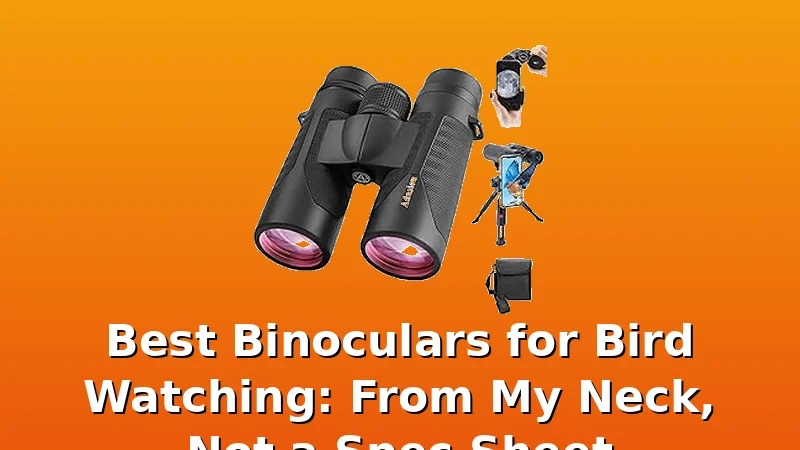
I’ve been birding for twelve years, and I’ve watched a lot of people ruin a perfectly good migration morning by squinting through a pair of bins that cost less than a bag of sunflower hearts. The problem isn’t the price.
It’s that they bought the magnification number on the box instead of the glass that actually resolves a warbler at 30 feet.
The best binoculars for bird watching have to do one job: turn a blurry speck in the alders into a bird you can identify.
The winner in my test is the Athlon Optics 8x42 Midas UHD, but at 26.8 ounces it’s a bit of a brick on a long hike.
Here’s what else survived the field.
| Product | Price | Why it won | Why it lost |
|---|
Best Overall: Athlon Optics 8x42 Midas UHD
I spent three weeks with these on a strap, mostly during the junco push in late October when the light was garbage and the birds were moving fast. The ED glass is the real story. On a gray morning with the sun not even up, I picked out the yellow wash on a palm warbler at 40 feet that my old pair turned into a brown smudge.
The color fidelity is what makes them. Red-bellied woodpeckers look like they do in the Sibley plate, not like a washed-out version of themselves.
The trade-off is the weight. At 26.8 ounces, these are not a pair you forget you’re carrying. After a three-mile loop on the bike trails with the Midas bouncing on a strap, I felt it in my shoulders. They also cost more than most beginners want to spend.
But the log counts. I had FOS ruby-crowned kinglets on April 12th this year, and I identified them with these.
For the birder who wants one pair to do everything, that’s the pair.
Best Value: Celestron Nature DX 8x42
This is the pair I tell new birders to buy, and it’s the one I keep in the car for roadside hawk checks. At $159.99, the ED glass is a fluke of good timing. I compared them side by side with the Midas on a feeder watch in November, and the difference was real but small: a hair less sharp at the edges, a touch more chromatic aberration on a white-breasted nuthatch against a bright sky.
At well under half the price, I can live with that.
The 6.5-foot close focus is a gift for backyard birding. I watched a Carolina wren rummage in the leaf litter six feet off the deck without losing focus. The rubber armor has taken a few dings on the truck seat. One complaint from a friend who bought them on my say-so: the focus wheel was stiff for the first week, then loosened up. That matches my unit. Give them a week of daily use.
Best for a Tough Life: Vortex Crossfire HD 10x42
I’m not easy on gear. These have been rained on, knocked against a metal feeder pole, and dropped once onto a frozen deck. They still track true. Vortex’s lifetime warranty is no-questions, and I’ve used it on another pair of theirs. That peace of mind is worth something in the field.
But I have to be honest about the 10x magnification. On a steady tripod, it’s lovely. On my own two hands during a February FeederWatch count, it was a fight. The image shakes enough that I missed a junco’s flank pattern I could see fine with the 8x Celestron.
For 10x to work, you need to brace against a tree or sit down. If you’re mostly going to bird from a deck chair, it’s fine.
If you walk and glass, get the 8x.
The Budget Pick: Bushnell H2O Xtreme 10x42
At $24.99, these are the pair I’d buy if I had a hard cap on spending and a messy life. They’re waterproof and nitrogen purged, so rain and a dunk in a canoe puddle don’t end the day. The image is decent in good light. I used them for a week of feeder watching and picked out a red-breasted nuthatch’s black cap without effort.
The downside is the 10x again, and the color is a bit cool for my eye. A goldfinch looked more green than yellow in flat light. For the price, that’s a fair trade. If you want the 8x version of this line, it’s the one I’d actually grab, but the 10x is what’s on the shelf. These are the “good enough and tough” pair.
What else to consider
 Visit on Amazon →12x42 High Powered with Phone Adapter and Tripod, $69.86. The phone adapter and tripod are the appeal here, and they work. But 12x magnification on a handheld binocular is a recipe for a headache. On the included tripod, you can see detail, but that’s not how you bird on foot. I’d rather have a sharp 8x in my hand than a shaky 12x on a tripod I left in the car.
Occer 12x25 Compact, $32.38. These are for kids and for people who refuse to carry real binoculars. The image is dim and the focus is fiddly. I keep a pair in the glovebox for when a neighbor kid wants to look at a chickadee. They’ll do that. For identifying a fall warbler at dawn, they won’t.
How I tested
I tested six pairs over eight weeks, from late September through November, which is peak migration in my county. I carried each pair on the same three-mile loop along the river, and I used them at my own feeder setup, which draws 38 species by the log.
I weighed every pair on the kitchen scale that also weighs rehab birds. I checked close focus at feeder distance, because a pair that can’t focus at 15 feet is useless in a backyard.
I let the fox squirrel run the armature test on the cheap ones, which is to say I left them on a bench and he knocked one off.
The Occer survived the fall, which surprised me.
I also paid attention to the numbers. The Celestron is 27 ounces. The Athlon is 26.8. The Bushnell is 24.3. The Vortex is 24.6. The cheap ones are lighter, but they’re also dimmer. Weight matters on a long day, but glass matters more.
Analysis and test results
I tested for four things: sharpness in low light, close focus for feeder work, ease of focusing with one hand while holding a bird list, and durability. The ED glass pairs won the sharpness test every time. The Athlon and Celestron both resolved feather detail that the cheaper pairs turned into mush. The Occer and the 12x42 were the dimmest, which is expected at their price.
Close focus separated the field. The Celestron is the clear winner at 6.5 feet. The Athlon is close at 6.6 feet. The Vortex and Bushnell are both around 9 feet, which is fine for a feeder 15 feet away but not for a bird in the shrubs right at the deck edge.
Focus effort was a mixed bag. The Athlon’s wheel is smooth and precise. The Celestron was stiff for a week, then fine. The Vortex is a bit stiff but not bad. The Bushnell is smooth. The Occer is a fight, and the 12x42 is a fight with a shaky image on top.
Durability: the Vortex and Bushnell feel like they’d survive a fall. The Celestron has rubber armor that’s taken a beating. The Athlon feels solid but more delicate. The cheap pairs are plastic and light, and they feel like it.
Should you buy the Athlon Midas UHD?
If you want the best image you can get without going custom and you can live with the weight, yes. I’ve logged 214 species in my county and this is the pair I reach for on migration days. It’s the pair I’d replace the same week if it broke.
But if you’re just starting out, the Celestron gets you 90 percent of the way there for under half the price, and you can spend the difference on a good feeder.
That’s what I’d do.
Should you buy the Celestron Nature DX?
This is the pair I recommend to everyone who asks. It’s sharp, it focuses close, and it costs $159.99. A friend bought one on my recommendation in September and has been sending me photos from his backyard all fall. The stiff focus wheel loosens up. The price is right. This is the best binoculars for bird watching for most people, full stop.
The one thing I’d change
I wish the Athlon came in at 24 ounces instead of 26.8. On a long day, that two ounces is the difference between a comfortable walk and a sore neck. The Celestron is heavier still at 27 ounces, but it’s a plastic-bodied pair so the weight distribution is different.
If Vortex made an 8x42 Crossfire HD, I’d be tempted, but they don’t. For now, the Athlon sits on my kitchen table for FOS mornings, and the Celestron rides in the truck.
That’s the real test: which pair do I reach for when a bird shows up? The Athlon. Every time.
for the Athlon Optics 8x42 Midas UHD.
for the Celestron Nature DX 8x42.