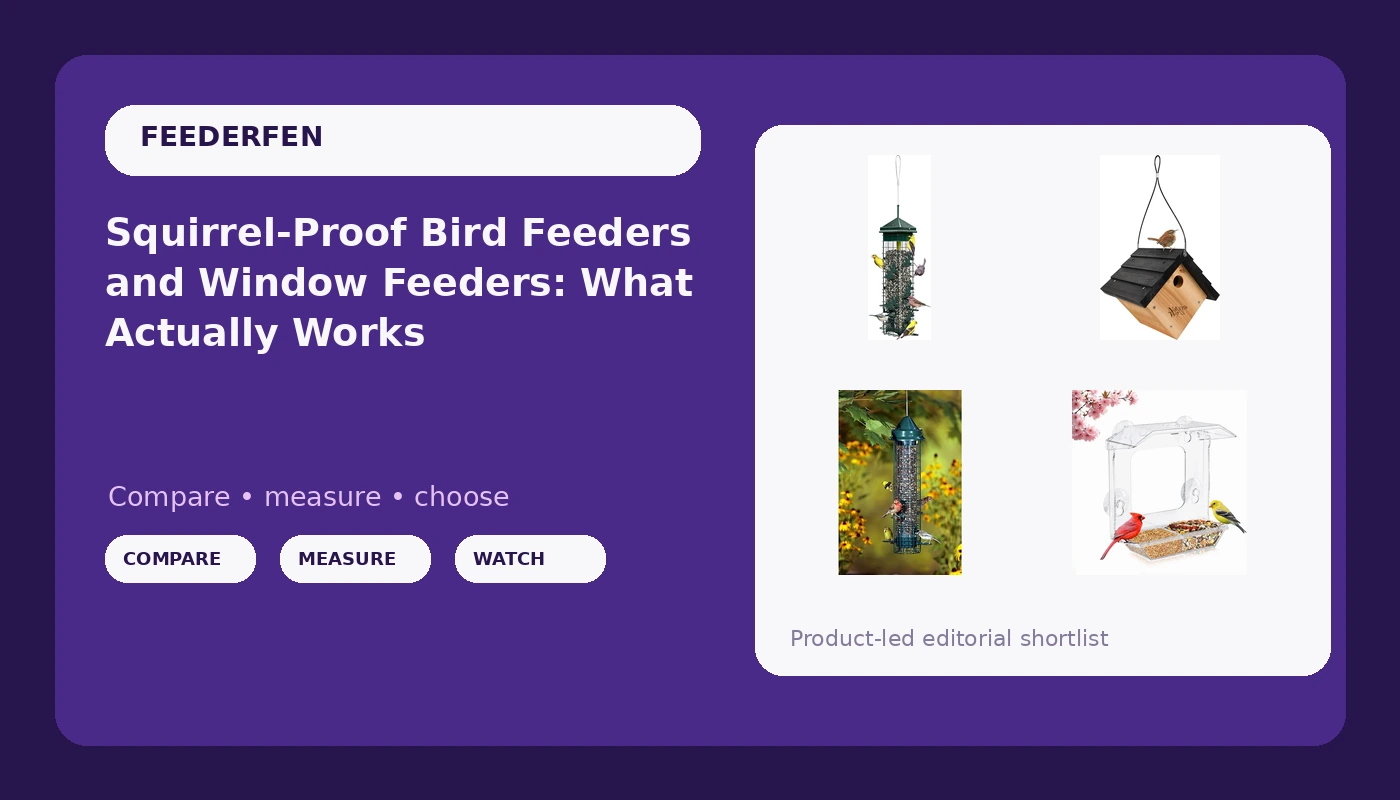
Every September the same question arrives, usually a day or two after the first fox squirrel finds the pole: which feeder actually keeps them out? Ten years of entries in the log, the spreadsheet where I record species visits, first-of-season dates, and cups of seed per week, have taught me that the phrase squirrel-proof bird feeder describes a system rather than a box. A feeder with weight-activated ports fails on a low shepherd's hook and works fine eight feet up a baffled pole. A window feeder has no squirrel problem at all, because there is no pole to climb. And some seasons the right purchase is not a feeder at all, but a cedar nest box that gives birds somewhere to go when the weather turns.
Related: How to Clean a Bird Feeder So You Actually Keep Doing It →
Quick answer
The short answer is to hang a weight-activated tube feeder on a baffled pole and accept that squirrel-resistant is the honest term for nearly everything on the market. Two of the four options below are built around defeating squirrels, one moves the food to your window glass where no squirrel can follow, and one is a cedar wren house for nesting season rather than feeding season. How well any of them performs depends far more on mounting height, baffle placement, and distance from a launch point than on the wording on the package.
4 useful options
| Model | Best fit | What stands out |
|---|---|---|
| Squirrel Solution200 Squirrel-proof Bird Feeder w/6 Feeding Ports, 3.4-pound Seed Capacity, Free Seed Funnel | Pole-mounted stations where squirrels already climb | Six feeding ports, 3.4-pound seed capacity, seed funnel included |
| Brome GC Bird Care - Squirrel Buster Feeder - Classic | Hanging setups on a pole arm or a baffled hook | Weight-activated port closure, the mechanism the Squirrel Buster line is built on |
| Window Bird Feeder with 4 Extra Strong Suction Cups (2.5 Inch) | Close-up viewing from indoors | Four 2.5 inch suction cups mount directly to glass |
| Nature's Way Bird Products CWH1 Cedar Wren House, 8" x 8.875" x 8.125", standard, Brown | Yards that want nesting habitat, not another seed station | Cedar construction at 8 by 8.875 by 8.125 inches |
Pole-mounted defense: Squirrel Solution200 Squirrel-proof Bird Feeder w/6 Feeding Ports, 3.4-pound Seed Capacity, Free Seed Funnel
The reason a pole feeder is the right starting point for most yards is that it gives you something to work with: a baffle can be mounted on the pole, the pole can be placed ten feet from the nearest launch point, and the whole assembly can be raised or lowered as the season changes. A feeder hanging from a branch gives you none of that control. The 3.4-pound capacity is worth thinking through honestly. In January, when juncos, chickadees, and house finches are hitting a station hard, that is a few days of seed, not a few weeks, so buy a feeder you can refill without disassembling anything.
Hanging tube defense: Brome GC Bird Care - Squirrel Buster Feeder - Classic
Weight-activated ports are the closest thing this hobby has to a real solution, and they are also the most misunderstood. The ports close when something heavy lands on the feeder, which means the feeder has to be the only route to the seed. Hung from a branch that a squirrel can reach by stretching down from above, or hung low enough to be grabbed from a fence, it becomes an ordinary tube feeder with a clever mechanism inside. Hang it from a baffled pole arm with nothing above it, and it does the job it was designed for. Bigger birds can also bounce off some weight-activated designs, which is worth knowing before you blame the feeder for an empty perch.
Closest view: Window Bird Feeder with 4 Extra Strong Suction Cups (2.5 Inch)
A window feeder earns its place for a reason that has nothing to do with squirrels: window strikes. Birds that hit glass usually do it after crossing a yard at speed, and a feeder mounted within three feet of the pane gives them no room to build that speed. That is the same reason I keep a feeder on the dining room glass where a white-throated sparrow once hit and spent three days in a shoebox. The honest caveat is suction cups. They are the weak point of any window-mounted feeder in a freeze and thaw cycle, and a tray that lets go in January lands on whatever is below it. Four cups instead of two is a real advantage, but check the seal every time you refill, and do not hang one over a hard surface you care about.
Beyond feeding: Nature's Way Bird Products CWH1 Cedar Wren House, 8" x 8.875" x 8.125", standard, Brown
Not every entry in the log comes from a feeder. House wrens and Carolina wrens are cavity nesters, and a box like this one is how you get them to stay past migration. Mount it six to ten feet up on a fence post, a shed wall, or a tree trunk, face the opening away from prevailing wind and afternoon sun, and leave it alone once it is occupied. Clean it out after the season ends, because a box that never gets emptied becomes a wet, matted mess by the following spring. If you are deciding where a limited budget goes, remember that a wren house costs less than most feeders and brings a species that seed alone will never pull into the yard.
Prices and availability may change. Product images, names, and retailer links must be matched by verified ASIN. Do not state a current price, rating, stock status, or measured result without current evidence.
What squirrel-proof really means
Squirrel-proof is a marketing phrase. Squirrel-resistant is a description of an arms race, and the arms race has rules.
The first rule is that squirrels solve vertical puzzles. A pole without a baffle is a ladder. A pole with a baffle that sits too low is a ladder with a step on it. A baffle works when it is mounted high enough that a squirrel cannot reach around it, and when nothing nearby, a fence rail, a low branch, a grill lid, gives it a launch point. If the log shows a feeder being emptied overnight with no hulls on the ground, a squirrel is taking the seed, and no product change will fix a mounting problem.
The second rule is that weight-activated ports need weight. A feeder that closes its ports under a squirrel has to be the only path to the seed, or the squirrel simply eats somewhere easier. This is why the same tube feeder earns completely different reputations in two yards on the same street.
The third rule is that cheap seed makes every feeder worse. Blends padded with milo and red millet get sorted through, the leftovers sit in the tray, they mold after a rain, and the feeder that "gets dirty fast" is really a seed quality problem. Sunflower hearts draw cleanly, leave no hull litter, and empty at a rate you can actually measure in cups per week.
The fourth rule is that hygiene outranks hardware. A dirty feeder is a disease vector with a perch. House finch eye disease and salmonella both show up in rehab intakes, and both trace back to feeders that nobody took apart in months. A feeder that is hard to disassemble is a feeder that will not get cleaned, no matter how good the squirrel mechanism is.
Placement, seed, and a five-step decision
Placement is where most of the outcome is decided, so start there and work backward to the product.
- Pick the mounting method first. If you have open yard, a pole with a baffle gives you the most control. If you have a balcony or a rented patio, the window feeder is the realistic option. If you want nesting birds as well as feeding birds, budget for a box and a feeder.
- Measure the distance to launch points. Ten feet of clear space in every direction is the goal. Trim branches, move the grill, and accept that a feeder near a fence is a squirrel feeder.
- Decide what seed you will actually buy every month. Sunflower hearts and no-mess blends draw well and leave little behind. Filler blends guarantee a cleaning problem you did not plan for.
- Check the cleaning routine before you buy. Can you take the feeder apart and get the inside of the ports clean in under ten minutes? If not, it will not get cleaned weekly, and weekly is the schedule that keeps a station healthy.
- Buy for February, not for June. Whatever you choose has to survive freeze and thaw, hold up under a full tray of wet seed, and still be worth hanging after four seasons.
Practical guidance for a Wisconsin winter
- Hang feeders within three feet of a window or more than thirty feet away, and never in the middle distance where a startled bird can build up speed.
- Take feeders apart and wash them with hot soapy water and a brush, then rinse and dry fully before refilling, at least once a week during busy months.
- Rake or sweep hulls and spilled seed out from under the station, because a wet layer of seed on the ground is what brings rodents and mold.
- Refresh the suction cup seal on any window feeder every time you refill it, and bring it inside during an ice storm rather than testing it.
- Keep a second feeder body dry and ready so the wash day does not leave the yard empty and the birds looking elsewhere.
- Check wattage and thermostat on any heated bath before it goes out, since a bath that runs hot in a mild spell is a hazard rather than a convenience.
Which option should you choose?
Choose the Squirrel Solution200 Squirrel-proof Bird Feeder w/6 Feeding Ports, 3.4-pound Seed Capacity, Free Seed Funnel when you have open yard, a pole you can baffle, and a mixed flock that empties six ports fast enough to keep the seed moving. Choose the Brome GC Bird Care - Squirrel Buster Feeder - Classic when you want a hanging tube on a pole arm and you are willing to give weight-activated ports a clear, unreachable hang point. Choose the Window Bird Feeder with 4 Extra Strong Suction Cups (2.5 Inch) when you want birds at eye level, you have no room for a pole, or you are feeding right next to glass and want the strike protection that comes with it. Choose the Nature's Way Bird Products CWH1 Cedar Wren House when nesting habitat is the gap in your yard and you want a species that no amount of seed will attract.
The caveat that applies to all four is that a product cannot out-perform its installation. A squirrel-resistant feeder on a low hook is a squirrel feeder. A window feeder over a concrete stoop is a risk. And nothing on this list replaces a weekly cleaning routine, because the log does not care how a feeder looks in a product photo, only how many cups it draws and how many birds stay healthy around it.
The bottom line
Buy for the mounting method you actually have, not the one in the catalog photo. If you have a pole, baffle it and put a weight-activated tube or a six-port station on top. If you have glass, a four-cup window feeder solves the squirrel problem by removing the pole entirely, with the honest caveat that suction cups are the first thing to fail in a hard freeze. And if you want the yard to hold birds beyond the feeding season, add a cedar box and clean it out once the nest is empty. Check current Amazon price on each option, compare it against the seed you buy every month, and spend the difference on a feeder you can take apart in under ten minutes.