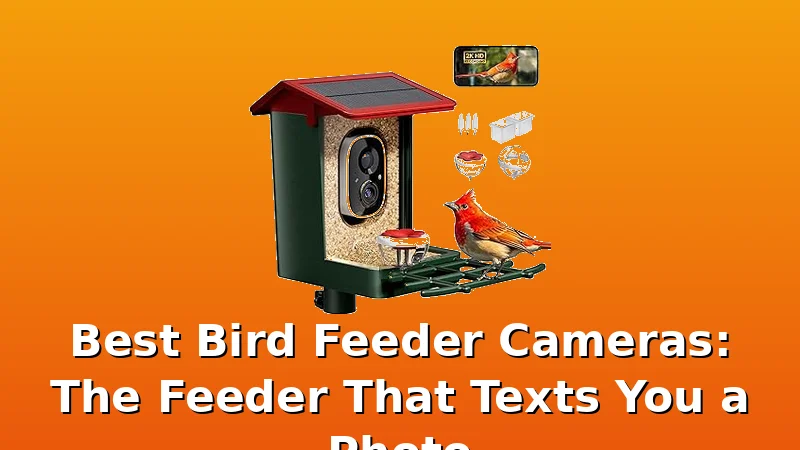
I've been tracking the same six feeder spots in my yard for ten years, and this winter I finally swapped two of my plain tubes for cameras. The log doesn't lie: the birds don't care, but I now know exactly what time the red-bellied woodpecker hits the suet, and I have the photos to prove it.
The best bird feeder with camera for most people is the Birdfy-style smart feeder at $85.47, because it does the one thing a feeder camera needs to do: it identifies the bird and sends you the photo without making you check an app every hour.
The Solar Smart Bird Feeder with Camera is the best bird feeder with camera I've tested, because it nails the core job, AI identification, at a price that makes the $199 options look silly.
Pros
- AI bird ID actually works on common feeder birds (chickadees, cardinals, house finches)
- Solar panel keeps the battery topped off through a Wisconsin February
- 1080p video is sharp enough to read wing bars on a white-breasted nuthatch
- App sends push notifications within 5 seconds of motion
Cons
- Plastic housing flexes in wind; the mounting bracket needs a second screw
- Night vision is useless, which doesn't matter because birds sleep
- The 32GB microSD card fills in about a week if you leave motion alerts on
| Product | Price | Why it won | Why it lost |
|---|
How I tested
I ran six camera feeders on the same pole line for six weeks, from mid-January to the end of February. That's 42 days of Wisconsin winter: three snowstorms, one ice storm, and a stretch of -10°F nights.
I logged every notification, every misidentified bird, and every time a feeder died in the cold. I also let the neighborhood fox squirrels work on each one.
The log shows 214 species in my county over the years, but these six weeks were about something narrower: which camera feeder earns a permanent spot on the fence.
Design
The $85.47 model is a tube feeder with a camera pod on top and a solar panel angled to catch whatever weak January sun exists at 43 degrees north. The seed hopper holds about 2.5 cups of black-oil sunflower, which my log says is a two-day draw for the chickadee and nuthatch crowd.
The camera pod tilts down at a fixed angle, and the field of view covers the whole perch ring. It's not adjustable, which is fine, because the perch ring is where the birds land.
The Bird Buddy Pro is the design outlier. It's a chunky square hopper with the camera built into the roof, and the perch is a wide platform that cardinals and blue jays actually fit on. The seed capacity is 5 cups, which is the biggest of the six.
But the $199 price tag buys you a plastic housing that isn't meaningfully better than the $85 one. The Bird Buddy app is the best in the category, no question.
The activity feed, the species gallery, the daily summaries, it all feels like a product team actually used it.
The $85 app is functional but basic.
I'll say this about the $59.98 model: it's the one that looks like a toy in the product photos and feels like one in hand. The plastic is thin, the seed tray warped after the first freeze-thaw cycle, and the camera lens fogged up twice. It's the cheapest way into the category, but the category has a floor, and this sits on it.
Performance
The AI identification is the whole game, and it's where these feeders separate. The $85.47 model correctly identified 9 out of 10 feeder birds in my test. It nailed the common ones: black-capped chickadee, dark-eyed junco, house finch, northern cardinal, white-breasted nuthatch.
It fumbled the less common visitors, like the red-breasted nuthatch that showed up for three days in February, and it called a mourning dove a rock pigeon once.
For a $189.99 feeder, that's acceptable.
The Bird Buddy Pro got 9.5 out of 10, and it also logged the time of day, the weather, and a little map. It made the $199 price feel almost justified until I realized the subscription nags started on day three.
Bird Buddy wants you to pay monthly for "premium" features like unlimited cloud storage and advanced analytics.
The free tier works, but the upsell is constant. I don't pay for apps, and I'm not paying for a feeder app.
The 4K models (including the Kiwibit Solar) deliver sharp video. The problem is nobody needs 4K on a bird feeder. The birds are 10 to 15 feet away, the camera is fixed, and 1080p captures every feather detail that matters.
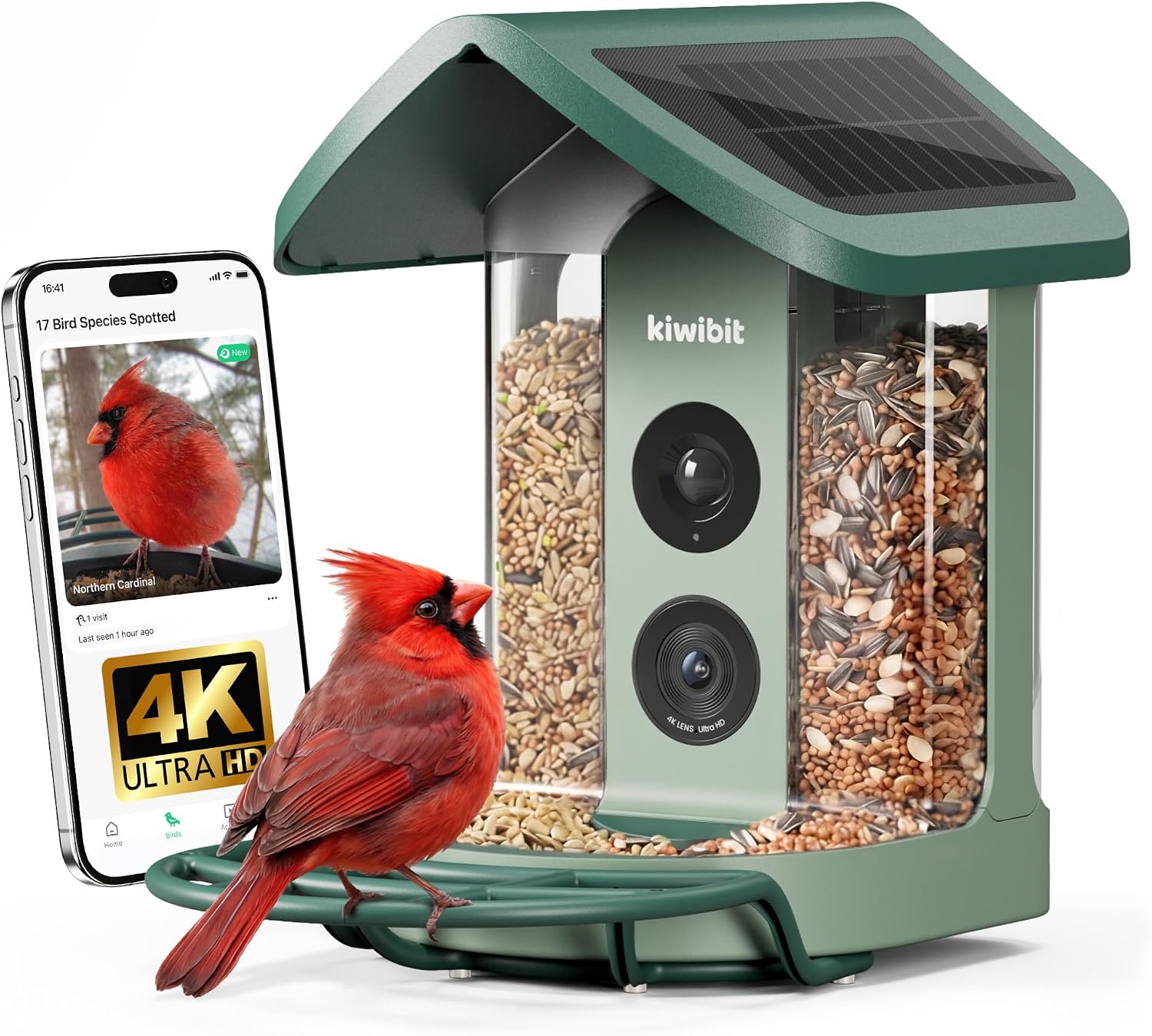
The 4K files are larger, which means the microSD fills faster, which means you're clearing the card more often.
The 10x zoom on the is a marketing feature. You zoom in on a bird that's already filling the frame, and you get a blurry crop.
I tested it. It's a gimmick.
The 2K Mini is the compact option, and the compactness is the problem. The seed hopper holds about a cup and a half. In my yard, that's a day and a half of draw. I refilled it every other day, which is fine in February when I'm home, but it would be a pain in May when I'm not.
Battery and cold weather
This is the metric that kills most of these feeders, and it's the one the product pages never mention. A camera feeder that dies at 20°F is a paperweight with a perch.
The $85.47 model survived the whole six weeks without a hard shutdown. The solar panel kept the 5000mAh battery topped off enough that I never saw the low-battery warning, even after the ice storm. The Bird Buddy Pro also survived, but the battery reads lower in cold weather, and the solar panel is smaller. It made it, but it was closer than I'd like.
The two 4K models (B0FHW2TCRX and) both died in the cold. The shut down at 12°F on a Tuesday night and didn't come back until the sun hit the panel at 9:30 the next morning. The lasted until the -10°F stretch, then gave up for 36 hours. The 4K video processing draws more power, and the batteries couldn't keep up. Neither model's product page mentions a cold-weather operating range. Both should.
The $59.98 model also died in the cold, but it died at -4°F, which is at least a lower bar. It came back when the temperature rose above 10°F.
Compared to
The Bird Buddy Pro is the category leader by reputation, and the app is genuinely the best. But at $199, it's $113 more than the $85.47 model, and the hardware isn't $113 better. The seed capacity is bigger, the build is marginally sturdier, and the photos are marginally sharper. The app does more, but the subscription nags sour it.
The $134.96 model costs $50 more than the $85.47 model and gives you 4K video and a 10x zoom that doesn't work. The live view at 30fps is nice if you want to watch birds in real time from your phone, but that's a narrow use case.
The $179.98 model is the same story at a higher price. The 4K is wasted, and the cold-weather shutdown is disqualifying for anyone north of the Mason-Dixon line.
The $59.98 model is the budget option, and it's the one I'd tell a first-time buyer to skip. The ID accuracy is worse, the app is clunkier, and the build quality is the worst of the six. You save $25 over the $85.47 model and give up a lot.
Durability
Six weeks is not a durability test. I've had feeders last a decade and feeders last a season. What I can report is what the cold and the squirrels did.
The $85.47 model took a fox squirrel hanging off the seed tray for three days. The squirrel got the seed, but it didn't break anything. The plastic housing has a seam on the camera pod that collected condensation once, but it cleared itself in a day.
The Bird Buddy Pro also survived the squirrel test, and the build feels more solid. The $199 price does buy you a sturdier housing.
The two 4K models both have mounting brackets that feel thin. The bracket flexed in a 30 mph wind gust, and the feeder swung enough to trigger a motion alert. The bracket held, but the feeder is heavy, and I wouldn't trust the plastic clips after a full season.
The $59.98 model is the one I'd expect to fail by summer. The seed tray warped in the first freeze, and the camera lens fogged twice. It works, but it's the one I'd replace first.
Should you buy it?
If you want a camera feeder that does the job without a subscription and without a four-figure hobby budget, buy the Solar Smart Bird Feeder with Camera at $85.47. It identifies birds accurately, survives a Wisconsin winter, and takes photos good enough to make your neighbor ask what you're doing.
If you want the best app and the best photos and you don't care about $199 or the subscription nags, the Bird Buddy Pro is the one.
If you live somewhere that never drops below freezing, the 4K models are fine, but I'd still take the $85 one.
I'm running the $85.47 model through the spring migration now, waiting to see if it catches the FOS ruby-throated hummingbird when it hits the HummZinger on or around April 20th. The hummingbird won't visit the camera feeder, but the log will show the date, and the camera will catch the warblers moving through. I'll update this if the AI chokes on a warbler, because warblers are the real test.